When Jesus was
asked if it was lawful to render taxes to Caesar, Jesus responds by
saying, “Give therefore to Caesar the things that are Caesar’s,
and to God the things that are God’s.” This statement was so
profound that it amazed those who heard it (Matt 22:22). I want to
examine the profoundness of Jesus statement, for I believe that it
has massive implications for us beyond "tithes and taxes".
"Give therefore to Caesar the
things that are Caesar's"
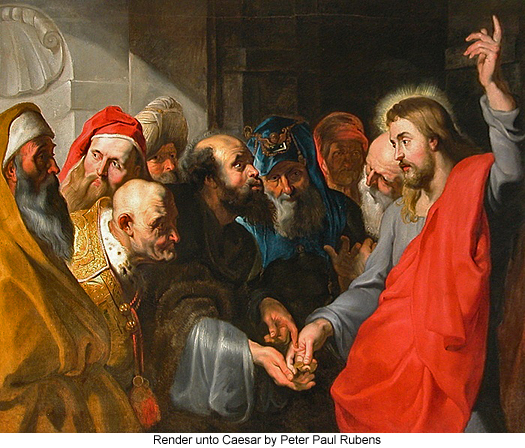
What
is it that belongs to Caesar? Jesus gives us a clue when the
Pharisees first ask if "it is lawful to pay taxes to
Caesar". Jesus responds
to their question by asking to see a piece of money. He proceeds to
ask whose image is on the coin and whose signature is on the coin?
Jesus is asking
who the coin belongs to. We know something belongs to us, because it
bears our image. Just look at your car or your office, it has your
image all over it. Not just in the pictures you hang on the wall,
but in how it's decorated and organized.
Does painter paint
a picture and leave it unsigned? No, he wants people to recognize
that which belongs to him. Look at your lunch in your office
refrigerator or the lunch a child takes to school. Their inscription
is on it to show ownership.
Jesus is saying
that all the money belongs to Caesar. That's right, all the money we
work so hard for, spending countless days slaving away for a few
coins that belong to someone else. And so when Caesar asks for what
he owns back, we are not giving taxes, we are rendering back the
property to the rightful owner.
So when God asks
for what rightfully belongs to him, that which bears his image and
his inscription, we are to render "to God the things that are
God's". To render God our lives, which bear his image and
mark, is not to do something extraordinary. You would never thank
someone for giving you back something that belongs to you. To not
render ourselves to God is nothing short of robbery.


