Friday, August 9, 2013

God's Eternal Purpose and Our Eternal Hope (Part 2 of 3)

In the last post, I talked about God re-creating everything, just as we are a New Creation in Christ, so Heaven and Earth will become new a the completion of all things.  Why does God make everything new?  Let's continue reading Revelation 21:1-7:

I saw the holy city, New Jerusalem, coming down out of heaven from God, 
I elaborated on this in my last post, but in summation, this New Jerusalem is the dwelling place of the saints, who are according to First Peter, the building blocks of the city.  And John sees Her coming down prepared like a bride adorned for her husband.


Throughout Scripture, this metaphor, of a husband and wife, is used as the relationship of God and his people. In Hosea God’s people are seen to be an adulterous wife... Paul tells the Corinthians that he is going to present them to Christ as a spotless bride. This bride is the culmination of the work of God. The virtuous wife of David’s Son spoke of in Proverbs 31. A helper suitable for God the Son. As in Genesis, when God made a companion suitable for his son Adam from Adam’s side. So the Father makes a helper suitable for the Second Adam, from Christ's side.

After Christ had died on the cross, his side was pierced, and out flowed the water to baptize and cleanse his bride and the blood by which he bought her. And it is from his side that God fashioned his Bride... the Church... You and me. Cleansed by the water, bought by the blood and confirmed by the Spirit. As John says there are three that testify: the Spirit, the water and the blood and these are in agreement. Do we accept this testimony? And this is the testimony God has given us eternal life and this life is in his Son. He who has the Son has life, he who does not have the Son of God does not have life. How wonderful it is to be included in God’s eternal purpose as the companion of His Son.

You see God’s eternal purpose is to bring glory to himself. His purpose is triune as He himself is triune in nature. God is a relationship between Father, Son and Spirit that has existed for all of eternity. And He seeks to share that relationship with that which he has made and purchased. That brings him ultimate glory! Here John sees this in his fullness and uses three examples to demonstrate this. We have seen the first one: Husband and Bride... A companion for His Son, one with which he will be equally yoked. We see how that relationship is “here, but not yet...” in the relationship between husband and wife. Husbands are to love their their wives as Christ loved the church and gave himself for her. Right now that relationship is damaged by sin, but here John of Patmos sees it in all it’s glory! How glorious it is.  

I heard a loud voice out of heaven saying, “Behold, God’s dwelling is with people, and he will dwell with them, and they will be his people, and God himself will be with them as their God.
As human’s isn’t there something special about where we dwell? We say that we want a liveable space, but what we really mean is something more relational than that. A place where we can live with the ones we love,
and converse, and eat meals together. A place of relationship is where we dwell. This is also what God desires as well. This dwelling is the restoration of what was lost in the Garden. The very dwelling of God with man, where Man and God could walk with one an other in the cool of the day.

The Holy Spirit, the Third person of the trinity Lived in the tabernacle in the wilderness, and lived among the people. And the Holy Spirit Tabernacles with in you and I, and with among us as the Church. For the Holy Spirit is the working of God among men.

Yet with this dwelling the Lord says by the mouth of the prophet Isaiah, “Heaven is my throne and the earth is my footstool, where is the house you will build for me? And where shall my resting place be?”

It is no coincident that John uses the same word here for dwell, which is literally tabernacle, as he does in his Gospel where he says that the Word dwelt among us. Yet even in flesh, the Word, very God from very God, Light from Light, could not find a place to rest. For He says, “Birds have nests and foxes have holes, but the Son of man has not a place to lay his head”.

The second person of the trinity tabernacled with us and identified with our weakness. But here the fullness of the Godhead is dwelling among men, and instead of identifying with our weakness, we are identifying with God’s glory and righteousness. In the dwelling of God, we shall rest, as we do now, but he shall also rest and commune with us. We will walk with him in the cool of the day, as Adam did with him in the Garden.

This Heavenly city... the place of God's people, of restored relationships is certainly the place the Psalmist speaks of when he says "For the Lord has chosen Zion, he has desired it for his dwelling... this is my resting place for ever and ever, here I will sit enthroned, for I have desired it"

Thursday, August 8, 2013

God's Eternal Purpose and Our Eternal Hope (Part 1 of 3)

As Christians we have an eternal hope, the hope of heaven and being with our Lord forever. But, what does this look like? What is summation of all things? Is it like being in a giant choir forever and ever? Do we become angels and sit on clouds and strum harps all day long?  That sounds less like heaven and more like...
well, anyway.

Is it relative? That is to say, does each person get their own personal heaven? this is an extremely popular view. Many religions of the world have this type of theory... Heaven or the afterlife becomes very personnel, just like a personal blissful, peaceful experience... something that is almost achievable if you got your hands on the right kinds of plants, if you know what I mean.

This "own personal afterlife" is so popular that even some humanists/atheists have theorized this type of after-life. The humanist and philosopher David Staume says that the odds of an afterlife are fairly reasonable, the odds of meeting God there is nil. His idea of a secular after life has been furthered by Bryon Ehlmann, a computer scientist and philosopher who calls the theory the "Neverending Dream".

To put it simply, both these men argue that when religions of the world speak of heaven, what they are referring to is a dream from which we do not wake up. Their argument is that if you never wake up, you will never know that you are dreaming.

Is this the hope we have as Christians? To peacefully and blissfully dream for eternity? Could this be the purpose for which we were made? God's grand finale?

Hardly.

Christians believe in resurrection and re-creation. We believe that God's purpose is bigger than just making things blissful for us. We believe heaven is here, but not yet... it is awaiting it completeness, when the kingdom of the world becomes the Kingdom of our Lord and of His Christ. When our relationship with him and with one another becomes healed, by the only one who can possibly heal, the one who is both God and man, Jesus Christ.

You see, heaven is not personal, it’s relational. We will be in the presence of God and one another, absent from the corruption of sin, forever. We won't be stagnet, because our relationship with God and one another will continue to grow and deepen over time.

This is when God's eternal purpose comes to fruition within our reality!

Revelation 21-22 is the final restoration of what was lost in Gen 3, when man fell into sin. It speaks to God's eternal purpose, to share the trinitarian life with those who are created in His image, bringing ultimate glory to himself. John describes his vision of the culmination of everything. His description is heavily rooted in the words of the prophets of the Hebrew Scriptures.

Let's look at the first seven verses of Revelation 21, as a starting place to begin to see God's eternal purpose and what our hope for eternity looks like.

First he says I saw a new heaven and a new earth:
John sees a complete fulfillment of the promises made in Isaiah 65:17-25; 66:22. This was the hope of Israel
and of the apostles: The New Creation. But, this New Creation is not only future. Sure will into it's fullness and be completed at the end of time, but Paul says in 2 Cor 5:17 “If any man be in Christ, he is a New Creation,” and just like John who says for the first heaven and the first earth have passed away, so Paul continues “the old is gone and the new has come”. We begin to experience the new creation here, in this life, here in our relationship with our family, our relationship with God. Remember the old has passed away, you are not enslaved as you once were, anxiety and anger, insecurity of what the future holds does not have to keep you up at night. He who has begun a good work in you will bring it to completion. In this vision John sees the work of God in us, be brought to completion. It is Gen 1 all over again.

and the sea is no more.
As a surfer this part has always kind of grieved me. But, John is saying so much more then “put away your surfer boards”. The sea in scriptures is often spoken of as a place of confusion and judgment. The promise here is that “God is not a God of confusion”, he is making things right. I’ll have to stick to surfing on the sea of glass.

I saw the holy city, New Jerusalem, coming down out of heaven from God,
Remember when Jesus told Nicodemus in John 3, “You must be born again”, in Greek “born again” is gennao anothen which means “born from above”. This New Jerusalem is from where one must be born (or be a citizen). And in Hebrews when the writer says that the OT saints were looking for a heavenly country, one built by God... This is that heavenly land. the Psalmist tells us in Psalm 87, “The Lord loves the gates of Zion more than all the dwellings of Jacob. Glorious things are said of you, O city of God:” Selah. Isn’t Jerusalem a dwelling of Jacob? Then why does God love the Gates of Zion more than all the dwellings of Jacob. The Zion the Lord is speaking of is one that He himself builds, where He Himself dwells with His people. It truly is the city of God. “I will record Rahab and Babylon among those who acknowledge me- Philistia too, and Tyre, along with Cush _ and will say “This one was born in Zion”... The Lord will write in the register of the peoples: “This one was born in Zion”
All these places mentioned are enemies of the city of Jerusalem according to the flesh, but the Lord will record those who are born of the Heavenly Zion in His register... the Book of Life. Is your name written in the book of Life?

The next part, we will see what is God's purpose in making everything new.  

Wednesday, August 7, 2013

Eternal Destiny of the Unevangelized

As people hear and are exposed to the Gospel and as the Spirit opens their minds so that they see the heart of God as revealed in Jesus Christ; naturally the question arises: What about those who have never heard the good news of Jesus Christ? They live this life without Him, must they spend eternity apart from Him because no one took the time to properly explain the gospel to them?

This question arises out of two truths taught by all Evangelical Christians: Namely God's universal love and that God has a particular plan for accomplishing this salvation. Repeatedly through Scripture we see that God loves all, but is determined to accomplish what He set out to do. This dynamic has lead to a debate within Evangelicalism over the eternal destiny of the unevangelized. Theological discussions of this sort are healthy, because as evangelicals, we must stop clinging to theology, and start clinging to the Gospel. The life, death and resurrection of Jesus Christ is the Gospel. As Martin Luther proclaimed, Crux sola est nostra theologia Therefore the answer to this question is not found in human reasoning, or in theological theories, but in what God reveals about Himself, specifically in the redemption that came by Jesus Christ.

First and foremost, Jesus Christ is the only Way to eternal life. Long before Christ was incarnated, God had made it known that He alone was the only Savior (Isaiah 43:11). In John 14:6, Christ declares Himself to be the only way of access to the Father. There is no access to God with out mediation, and there is only "One Mediator between God and men and that is the man Jesus Christ."(1 Timothy 2:5).  He [Christ] introduces and presents the person and services of his people to his Father, and gives them acceptance with Him.

Therefore all ideas of pluralism must be abandoned. Pluralism is the view that holds that Jesus is only one of many saviors throughout the different religions of the world. This idea has been rejected by mainstream Christianity, because it regards Christ as not unique. God always refers to a sin moment in time when takes away sin (Zechariah 3:9) and only God's Arm brings salvation (Isaiah 51:5); and Jesus Christ is that Arm (John 12:38). Only the Word incarnate could be Savior of the world.

Since Scripture testifies that there is only one Savior, Jesus Christ the Only Begotten of the Father (John 1:18); it must be assumed (and all evangelical Christians would agree) that He is ontologically necessary for the salvation of the world(1 Corinthians 15:17; Romans 5:10; Titus 2:11-14; 1 John 2:2). That is all are saved through Christ, but do all have to know about Christ? At first glance it may seem obvious that to have faith in Christ, you must know about Jesus, but one must take into account the Old Testament saints. They were saved through Christ, but did they know all the facts about their redemption? It is at this point that evangelical Christians can be split in to two different camps, exclusivism and inclusivism.

Exclusivists hold that Jesus is the only Savior for all humanity, and that it is not possible for anyone to be saved apart from explicit knowledge of Christ and the Gospel. But therein lies a problem, how can God "desire all men to be saved" (1 Timothy 2:4) if some people never get the opportunity to hear the Gospel and thus can not be saved. To fix this logical problem in exclusivism, there are three views that have been espoused from Scripture.

The first view is called the "Restrictivist View". Restrictivist theologians teach that all men are judged by what they know, thus the unevangelized are judged by what they should have known from creation (Romans 1:18-22). R.C. Sproul says that "if a person in a remote area has never heard of Christ, he will not be punished for that. What he will be punished for is the rejection of the Father of whom he has heard [through creation] and for the disobedience the law written on his heart"

It appears if this view is to be consistent, that there is no salvation for a child (born to unsaved parents) who dies in infancy, no salvation for people who died before missionaries could reach them, no salvation for those oppressed by a cruel tyrant, and no salvation for the mentally handicapped. In response to an objection of unfairness and cruelty, many restrictivists echo Paul's statement "But who are you, O man, to talk back to God? "Shall what is formed say to him who formed it, 'Why did you make me like this?'"(Romans 9:20). God knows what's best for us, He knows the great work he is accomplishing, so He is not unfair, He is good (Matthew 20:13-15).

Some exclusivists believe that one way or another, all who have a heart to believe will be given an opportunity. This group properly observes that in Scripture, God holds out His hands to a rebellious people (Romans 10:21), that He wants all men to be saved (1 Tim 2:4), and that He is the "rewarder of those who diligently seek him" (Hebrew 11:6). Also throughout Scripture people are brought to the knowledge of the Truth by supernatural experience. Some New Testament examples are Paul the Apostle (Acts 9), the Ethiopian eunuch who was seeking truth (Acts 8), and Cornelius who also was trying to be faithful to God (Acts 10). This view is largely an Arminian stand point, because from the stand point of Calvinism, this is just God working out His elective purposes. Since in Calvinism God will not fail to save those who he has chosen, one could be a restrictivist and still hold to this as a way that God seeks out His elect.

Another view point that exclusivists esponged from Scripture is the idea of postmortem evangelism. Again, this idea springs from the fact that the theme of Scripture is that the Creator loves and cherishes His creation and does not want any to perish (2 Peter 3:9). Not only that, but Christ has defeated death that held the human race hostage since the fall.(Hebrews 2:14; 1 Peter 3:18-20). Death is not the dividing line for the love of God. For there is no death that except that which ends in resurrection (Daniel 12:2). Furthermore, even Christ tells Thomas, "Because you have seen me, you have believed; blessed are those who have not seen and yet believed". Is Thomas any less an apostle because he had to see in order to believe? Certainly not, Jesus just refers to those who believe without seeing as "blessed".

Some may argue that Hebrews 9:27 rules out any possibility of postmortem conversion, but, when taken in it's context, Hebrews 9:27 declares no such thing. In fact Paul in comparing "Just as man is destined to die once, and after that to face judgment" with "Christ was sacrificed [died] once to take away the sins of many people [judge sin]"; he leaves no doubt what he is speaking about. "As man dies but once, Christ was offered but once, or he suffered and died but once...".  Paul is speaking to the completeness and effectiveness of Christ's sacrifice.

Postmortem salvation stops just short of being "inclusive", because it demands that someone not only must be saved through Christ, but they must know that they are being saved through Christ. Though inclusive and exclusive views believe much the same things about God and Christ being the only way to salvation, they part ways in the exclusivities assumption that a person must explicitly know about and believe in Jesus. All people are saved through Christ, whether or not they know it.

The Bible declares that at no time has God left Himself without a witness. (Acts 14:17). Scripture also teaches that God in Christ reconciled the world to Himself, because He loves us and does not want to see anyone perish (2 Corinthians 5:19-20; 2 Peter 3:9). Thus, He has provided a witness for the entire world. (Psalm 19:1-4; Romans 10:18). Paul says that the Gentiles have the law of God written on their hearts and their consciences condemn them.(Romans 2:14-16). Wesley says, "What is vulgarly termed natural conscience, pointing out at least the general lines of good and evil. And this light [who is Christ], would shine more and more to the perfect day".

Hebrews 11 speaks of the faith of those who died before receiving the promise of Christ. They didn't know Christ, but they believed the promises of God. In the same chapter the testimony of Scripture reveals that without faith it is impossible to please God, because anyone who comes to him must believe that He exists and reward those who seek him. (Hebrews 11:6). Though the Cross of Christ is absolutely necessary for humanity to know (and fully understand God), God clearly rewards those who are seeking after Him. Simply put, this view sees God as applying the finished worked of Jesus Christ to all who have the heart to receive it.

Though all four of these evangelical views are backed with Scripture, there is speculation in all of them. So lets look at what Scripture says on this:

First, as all evangelicals agree, God's love in universal (Psalm 145:9). In fact the Bible declares that God himself is Love (1 John 4:16), and Love is the proper name for the Holy Spirit of God. Scripture also declares that the God we worship is just (Isaiah 30:18, Psalm 45:6). Sometimes as men we can warp what justice is, but Scripture declares what the justice of God is: to show mercy and compassion (Zechariah 7:9).
Second, in Christ we see God's true nature. Jesus Christ, the very Word of God, on a rescue mission, from the womb of a virgin, is born to reveal Himself, and conquer death and bring life. God demonstrates in Christ that He is willing to do anything to restore mankind. How great the Father's love for us.
The life, death and resurrection of Christ demonstrates God's true Love ( 1 John 4:10), and also his true justice (Luke 4:18). In Christ, we see a God who pursues us by His love, one who wants to comfort and protect all he has made, even those who reject Him. (Matthew 23:37). Even forgiving those who kill the very Word of God (Luke 23:34).

The salvation of God is a relationship with a person, not an act.(Psalm 35:3; Luke 1:77) Salvation is already established through Jesus Christ. God has married us to Himself in Christ, He will never divorce mankind (Isaiah 50:1). Our sin separates us and sells us in to slavery (Isaiah 50:1). But Christ came to conquer sin and death. We are united with Christ, in faith, we either affirm the reality or we deny it. Therefore whatever happens in the end, it will not be because of the deficiency in the motive, mind or effectiveness of what Christ did on our behalf. Even outright rejection of Christ can be forgiven (Matthew 12:32), but rejection of the love of God (which is the Holy Spirit), can not be forgiven.

So what about those who never heard? Or what about those who have rejected a "gospel" message the represented a false Christ? They are all included in Christ, God loves and died to free them all from the tyranny of Satan. (Colossians 2:15;2 Timothy 2:26; 1 Corinthians 15:22-25). God, the owner of the vineyard, is restoring His vineyard by planting the True Vine. The mystery is not how the unevangelized will be saved, the mystery is that there will be people, who know the truth and will reject Love for all of eternity. But even to those, God has promised that the gates of the Holy City will never be shut (Rev 21:25).

Tuesday, August 6, 2013

Dear 15 Year Old Me (Turning 30)

Today I turned 30...

I am getting pretty old... Stop rolling your eyes, when you are always surrounded by teenagers, 30 feels ancient.  Being a youth pastor, I make a living teaching and giving advice to young people.  So on the occasion of my 30th birthday, I will give my 15 year old self advice... with the benefit of hind sight of course...

Just so we are clear, I stole this exercise from Campus Life:

Dear Fifteen Year Old Me,

It's me, or should I say it's you... fifteen years from now.  Without giving too much away, you are a youth pastor in a small town in Nebraska.  Stop laughing... it's not funny!  Whatever don't believe me, you'll see.   Anyway, I have some advice for you, that I hope to you take to heart over the next fifteen years.

1) You are NOT the master of your own destiny, the captain of your own ship.  God is sovereign over you and your life.  Keep him at the center, He is the only one who will never leave you nor forsake you.

2) Don't let anger get the best of you.  Realizing that God is in control (total control) and casting your cares on him will help you keep anger in check.  He really is faithful and will not let you fall.

3) Pursuing wealth sucks.  It adds to your anxiety and is pointless.  You will travel and have many adventures all around the world, but when you pursue wealth (ironically so you can travel and have adventures), your life will become stagnate.

4) Stay out of debt (especially with the IRS, they are mean), not by making tons of money, just don't buy useless crap.

5) Take pictures and journal so you can remember places, people, things, victories, failures, and through the whole thing see the hand of God.

6) God is the Grand Story Teller.  Stop trying to write your own story, let Him do it.  When we focus on Him, we can hear the the strokes of his pen in our hearts.

Well that what I have for you.  Stay strong in the Lord and in the power of His might.  Oh, one more thing, you really aren't that good at Water Polo.

Love,

Pastor RJ (stop snickering, I'm serious)


Thursday, July 11, 2013

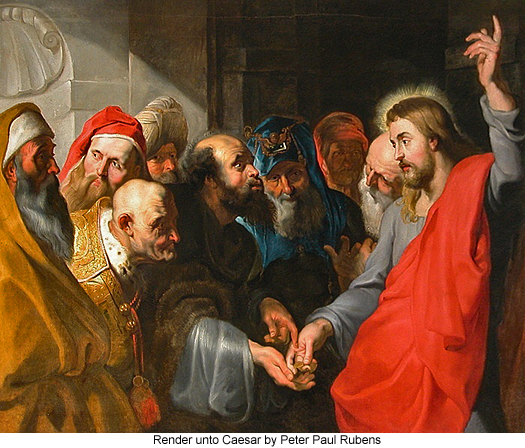
Render to Caesar

When Jesus was asked if it was lawful to render taxes to Caesar, Jesus responds by saying, “Give therefore to Caesar the things that are Caesar’s, and to God the things that are God’s.” This statement was so profound that it amazed those who heard it (Matt 22:22). I want to examine the profoundness of Jesus statement, for I believe that it has massive implications for us beyond "tithes and taxes".

"Give therefore to Caesar the things that are Caesar's"


What is it that belongs to Caesar? Jesus gives us a clue when the Pharisees first ask if "it is lawful to pay taxes to Caesar". Jesus responds to their question by asking to see a piece of money. He proceeds to ask whose image is on the coin and whose signature is on the coin?

Jesus is asking who the coin belongs to. We know something belongs to us, because it bears our image. Just look at your car or your office, it has your image all over it. Not just in the pictures you hang on the wall, but in how it's decorated and organized.

Does painter paint a picture and leave it unsigned? No, he wants people to recognize that which belongs to him. Look at your lunch in your office refrigerator or the lunch a child takes to school. Their inscription is on it to show ownership.

Jesus is saying that all the money belongs to Caesar. That's right, all the money we work so hard for, spending countless days slaving away for a few coins that belong to someone else. And so when Caesar asks for what he owns back, we are not giving taxes, we are rendering back the property to the rightful owner.


So when God asks for what rightfully belongs to him, that which bears his image and his inscription, we are to render "to God the things that are God's". To render God our lives, which bear his image and mark, is not to do something extraordinary. You would never thank someone for giving you back something that belongs to you. To not render ourselves to God is nothing short of robbery.

Wednesday, July 3, 2013

Book Review: "The King Jesus Gospel" by Scot McKnight

Many people ask the question, "Did Jesus and Paul preach the same gospel?".  On occasion some people say "no", but more often than not, a student of the bible would answer with a resounding "yes".  But, in his book "The King Jesus Gospel", Scot McKnight uses this question to show how far the church has fallen from proclaiming the Gospel that Jesus, Peter, Paul and the rest of the disciples preached.

McKnight steps through the Bible to show that the Gospel is the completion of Israel's story (and therefore the world's story) in the person and work of Jesus Christ.  He shows that this is the message preached by Jesus and the apostles.

This Gospel, McKnight claims, has been overlooked in favor of the "plan of salvation" that most evangelicals proclaim.  Outside of the story of the Gospel, the plan of salvation seems like a work we do in order to be saved.  McKnight also says that "personalizing" the Gospel, makes salvation more about the person than the God who does the saving.

It took me quite a while to get through this small book.  It has a lot of good information and is not very long, but I think it probably could have been 75-100 pages shorter (it is only 175 pages in length).  It serves as a great reminder about what the true Gospel is.  Jesus truly was the messiah that we all have been waiting for.